At Ayala Tree Services LLC, we know a peaceful garden can hide safety risks. Weak branches may look normal until wind, rain, or decay causes damage. Therefore, learning the warning signs helps protect your trees, home, garden beds, and family before a limb falls.
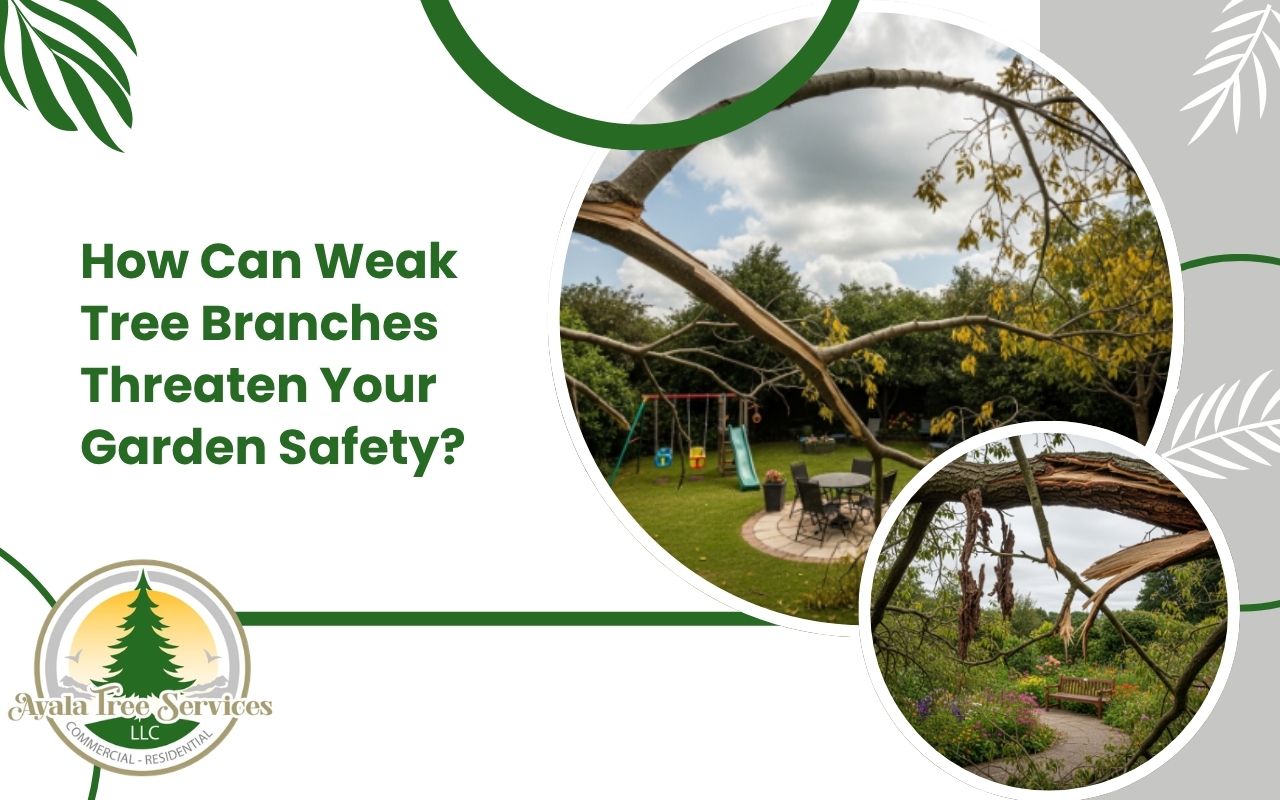
How Can Weak Tree Branches Threaten Your Garden Safety?
Weak tree branches threaten garden safety when cracks, decay, poor attachment, or storm stress make limbs more likely to break. Early checks, safe pruning, and timely professional help reduce branch failure, protect nearby structures, and keep outdoor spaces safer.
Weak tree branches are limbs that lack strong structure, healthy wood, or secure attachment. Homeowners, property managers, and garden owners need to spot them early because they can damage roofs, fences, plants, and people. This problem is solved through inspection, pruning, support, or safe removal.
Spot Early Warning Signs Before Branches Break Apart
Early warning signs help you act before a branch falls. Cracks, dying leaves, fungus, poor branch angles, and old cuts can show hidden weakness. Therefore, a careful visual check can prevent damage before storms, heavy rain, or strong wind add more stress.
At Ayala Tree Services LLC, we check the canopy, bark, branch collar, and nearby targets. Moreover, we explain what looks normal and what may need care. Some pruning signs are easy to miss, especially when leaves hide old wounds.
- Look for cracked limbs with open bark or exposed inner wood.
- Watch for dead leaves on one branch while the tree stays green.
- Check for mushrooms, cankers, or soft wood near branch unions.
- Notice branches that lean, sag, rub, or cross tightly.
- Review old cuts that left stubs or damaged collars.
Cracked limbs often signal stress inside the branch, even when the rest of the tree looks healthy.
Reduce Safety Risks With Timely Branch Care
Timely branch care lowers the chance of sudden breakage. Falling limbs can damage sheds, fences, vehicles, windows, and garden beds. Also, smaller limbs can still injure people when they fall from height or swing during a storm.
Weak wood can also invite pests and decay. As a result, one damaged limb may become a larger tree health problem. According to University of Minnesota Extension, weak branch unions and decay can increase storm damage risk.
- Remove dead or broken limbs before they fall.
- Keep heavy branches away from roofs and walkways.
- Address fungus, oozing sap, and soft wood quickly.
- Avoid standing under damaged limbs after wind or rain.
- Call for help when branches hang over people or property.
Branch failure is more likely when decay, weak attachment, heavy foliage, and storm pressure act together.
Assess Tree Health Through Simple Garden Checks
Simple garden checks reveal whether a tree needs pruning, support, or removal. Start at the roots, then look up through the trunk and canopy. In addition, compare both sides of the tree to find imbalance, leaning limbs, or dead sections.
Ayala Tree Services LLC looks for soil movement, exposed roots, hollow sounds, fungus, and poor branch collars. Then, we guide customers through safe next steps. However, homeowners should not climb trees or cut limbs near wires.
- Safer to monitor: small dead twigs, minor rubbing, or light canopy imbalance.
- Needs pruning soon: cracked limbs, crossed branches, or weak narrow angles.
- Needs urgent help: hanging limbs, trunk splits, root lift, or storm damage.
- Needs professional review: large limbs over roofs, driveways, sidewalks, or play areas.
A weak branch over a walkway, roof, or driveway should be treated as a safety concern, not only a tree care issue.
Prune Damaged Limbs Using Safer Cutting Methods
Proper pruning protects the tree while removing risky limbs. Clean cuts near the branch collar help the tree close wounds better. Furthermore, the right method reduces torn bark, open stubs, and future weak growth.
For small limbs, use sharp, clean tools. Also, cut just outside the branch collar without cutting into the trunk. For larger limbs, the UGA Extension recommends a three-cut method to reduce bark tearing.
- Make a lower cut away from the trunk to reduce tearing.
- Make a second cut farther out to remove branch weight.
- Make the final cut outside the branch collar.
- Clean tools between trees when disease may be present.
- Stop and call a professional for tall, heavy, or hanging limbs.
Ayala Tree Services LLC recommends professional pruning when branches are high, heavy, storm-damaged, or close to structures. Therefore, do not risk injury for a cut that needs special tools.
Strengthen Trees With Preventive Maintenance And Support
Preventive maintenance helps trees grow with stronger structure. Regular inspections, balanced watering, mulch, and careful pruning reduce stress over time. Also, structural support may help some large limbs when removal is not the best first choice.
Young trees need early training because wide branch angles often make stronger attachments. Meanwhile, mature trees may need selective thinning, structural pruning, cabling, or bracing. These steps should fit the tree species, site, and safety risk.
- Keep mulch away from the trunk base.
- Water during dry periods without soaking the soil.
- Thin crowded limbs to improve air and light flow.
- Remove dead, diseased, or rubbing branches early.
- Inspect trees after strong wind, heavy rain, or ice.
Preventive pruning is often safer and less stressful than emergency cutting after a limb has already failed.
Follow This Simple Plan For Safer Trees
A simple plan helps you respond with calm and care. First, observe the tree from the ground. Next, identify visible risks. Then, decide whether the branch is safe to monitor, prune, support, or review professionally.
- Check the canopy for cracked limbs, dead leaves, fungus, rubbing branches, or uneven weight.
- Review nearby targets, including roofs, walkways, garden beds, vehicles, fences, and play areas.
- Plan safe pruning for small damaged limbs only when the work can be done from the ground.
- Protect long-term growth with watering, mulch, inspection, and structural pruning when needed.
For urgent hazards, review our urgent warning guide before approaching damaged trees.
Frequently Asked Questions
How do I know if a branch is weak?
A branch may be weak if it has cracks, dead leaves, fungus, soft wood, or a narrow attachment. Also, a limb that hangs over a roof or walkway needs extra attention. For urgent signs, read our urgent warning guide.
When should I call for help after storm damage?
Call for help when branches are hanging, split, leaning, or close to power lines, roofs, cars, or walkways. Additionally, avoid cutting heavy limbs yourself. Our storm response tips can help you choose safer next steps.
What happens if cracked limbs are ignored?
Cracked limbs can worsen during wind, rain, or heavy foliage growth. Eventually, the branch may fail and damage nearby plants, structures, or people. Therefore, early inspection and pruning can reduce the chance of sudden breakage.
Why is pruning important for branch safety?
Pruning removes dead, damaged, rubbing, or poorly attached limbs before they become larger hazards. Also, careful pruning can guide stronger growth. For service questions, use our schedule a safe tree check page.
How do I decide between pruning and removal?
Choose pruning when the tree is mostly healthy and the risky limb can be safely removed. However, removal may be needed when the trunk, roots, or main structure is unstable. A professional inspection can explain the safest option.
Protect Your Garden With Confident Tree Decisions
Ayala Tree Services LLC is ready to help you inspect, prune, clean, repair, or remove unsafe limbs with care. Therefore, if your garden shows warning signs, schedule a safe tree check and keep your outdoor space safer.